Who the AI portrays
The Character Info guide asks for background, traits, behavior and reactions. Replace a vague adjective with a visible habit: an adult courier who checks a receipt number before handing over a parcel.
 Rochat Workshop
Character / player / world
Build a character with a reason to act. Give the player a role. Add game state only when the story needs it.
Discover Another Story
A character is more than a description.
Decide how they respond.
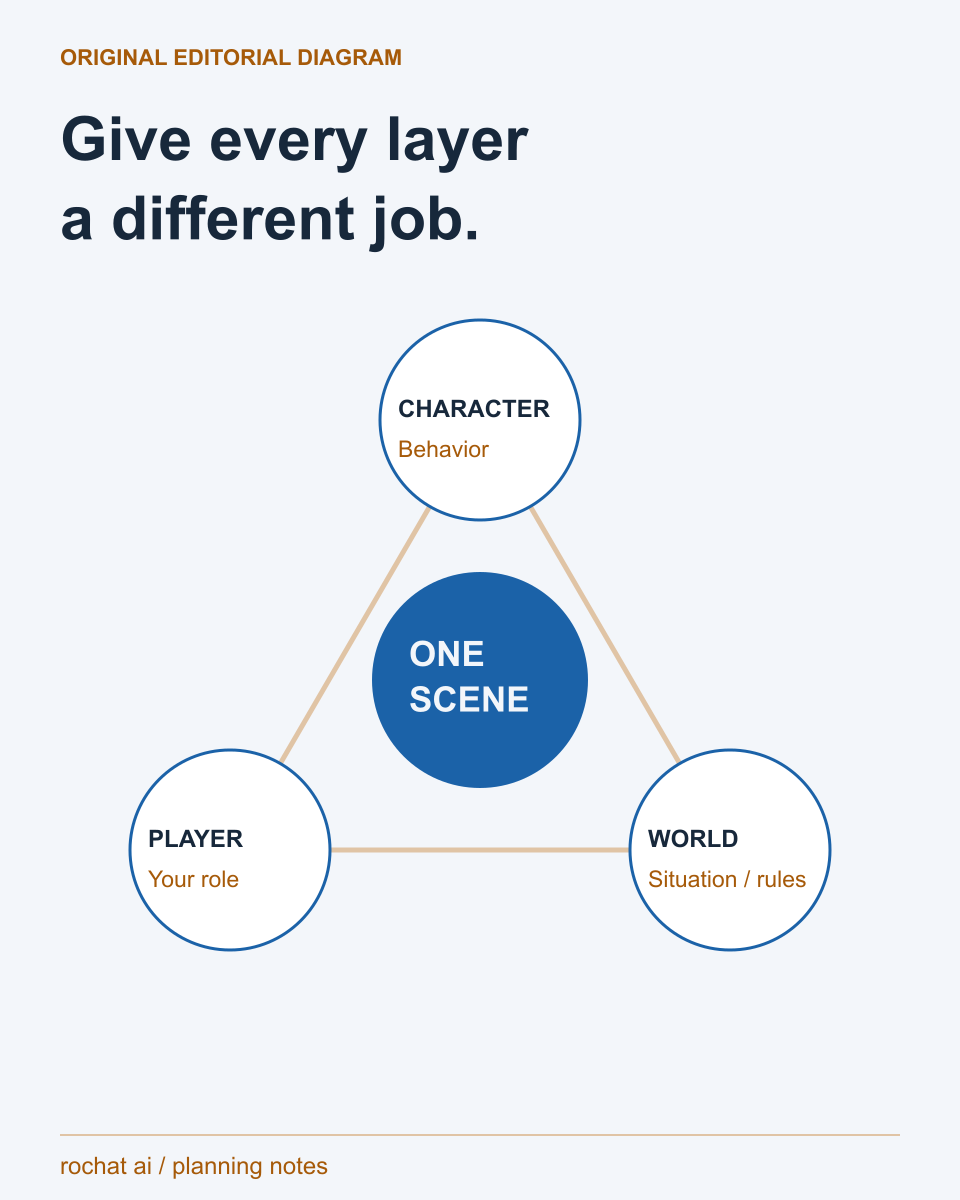
Three layers. Three different jobs.
The Character Info guide asks for background, traits, behavior and reactions. Replace a vague adjective with a visible habit: an adult courier who checks a receipt number before handing over a parcel.
The persona guide documents user background in profile settings, including defaults for new chats. A player persona should not quietly redefine the AI character.
The AI AVG guide adds scenes, objectives and values. Use them when reaching a goal matters, rather than adding counters because a game interface allows them.
Give each control one job
Public Info describes the discoverable card and profile; the guide explicitly says it does not affect chat prompts. “A careful adult courier with a parcel to return” introduces the character without revealing a solution.
The Scenario guide describes a permanent prompt influencing each dialogue round. Put the fictional situation here: the receipt is smudged, two addresses are possible, and the recipient must be identified before delivery.
The separate game guide reserves up to 1,500 tokens for hidden clues, behavior and transitions. For this example, specify how checking the receipt resolves the address; a “hidden” field is not a confidentiality guarantee.
An original field-mapping example. Character authoring and AI AVG game controls are separate documented routes; this is not a running game or a tested preset.
Make state explain the story
The game guide requires separately named integer values: exactly one success value, whose final value exceeds its initial value, and at least one failure value. These belong to AI AVG’s numeric system, not Public Info or a character’s ordinary biography.
The documented {char} and {user} variables point to character and player. Do not invent a named placeholder and assume it is supported. An AI narrative is also not a deterministic game engine: inspect its behavior instead of relying on the counter alone.
No game mechanics are necessary to write a coherent character brief. Start with personality, relationship and a current goal. Add an objective system when state and endings contribute something the conversation alone does not provide.
No. The Scenario page describes a permanent prompt influencing each dialogue round. That does not establish unlimited conversation history or perfect obedience. Keep stable identity separate from the changing scene and review contradictions while they are small.
Rochat Book describes itself as an evolving guide. Its authoring pages support this workshop, but present account limits, pricing and game execution were not tested.
Five comparisons examine game rules, character setup, player identity, anime tools and prepared visual interactions.
Distinguish persistent character facts from causal game state before building a small clue-finding scene.
Understand the difference between defining the user’s role and choosing the AI companion’s appearance and personality.
Turn a fixed rescue-story outline into a playable objective, distinguishing author-written consequences from generated roleplay.
Separate a character’s discovery description, content rating and hidden behavior instructions before editing the wrong control.
Compare author-defined objectives and scene rules with prepared AI-room interactions and predefined video clips.